
Amid the anger about Redbridge’s decision to introduce nine daily market stalls on Wanstead High Street – and the perceived inadequate consultation before the decision was made – one unanswered question is puzzling.
Why, in a change to a policy which applies across the whole of Redbridge, are more than 25% of the new sites in Wanstead? What have Wanstead shopkeepers and residents done to attract this special attention?
In other market stall news:
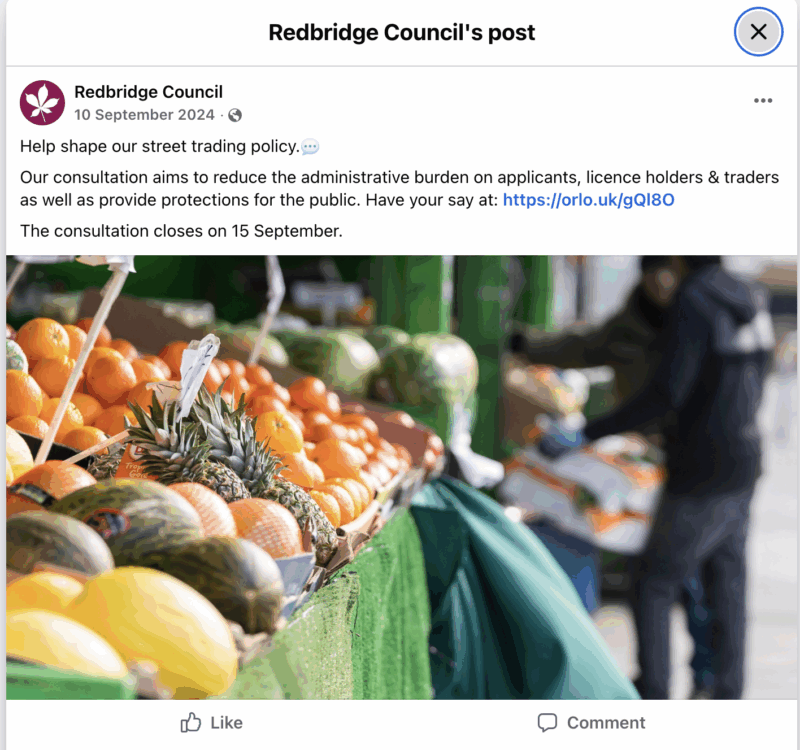
* Detective work by residents has surfaced the adverts which made up the consultation last year, which we understand had 80 responses in total and had to be extended because of a poor answer rate. This is the advert that appeared on Facebook (spot the mention of market stalls). It’s fair to say this is opaque at best.
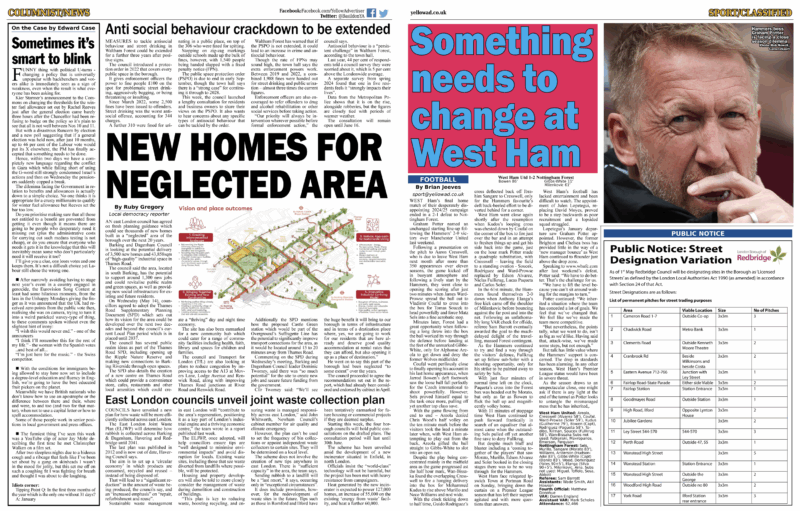
And this is the notice which appeared on an inside page in editions of the Yellow Advertiser last year, a newspaper which – it turns out – is not actually printed any more. Also note the use of the phrase “permanent pitches for street trading purposes”, something which contradicts Redbridge’s statement that they would not be permanent.
- Paul Canal, leader of the Conservative opposition at Redbridge, has written to Redbridge leader Cllr Kam Rai calling for the current process to be halted and for the consultation to take place again. He wrote:
“Wanstead’s high street is one of Redbridge’s best assets. It must not be subjected to poorly considered changes introduced without meaningful local input. The Council has a duty to listen and to act in the best interests of those it serves.” - The petition against the stalls has now climbed to more than 1,200 signatures.
Thank you Cllr Kam Rai. I don’t want to see a little Romford or little Ilford here. Because if it goes ahead on behalf of us with mobility and balance issues it will be a disaster of our social life. I belong to Walk for Health. Some of us which Iead is called Lei’s Strollers. We always use the high street for our walk on Saturdays,(I do it daily, weather permitted). On behalf of the wonderful hard working shop keepers, the market stall owners should pay a much higher rate because their income in some cases can be much lower.
I think the obstructions from these stall would be hugely detrimental to people with mobility issues or a disability. They would also put the shopkeepers, who pay rates, rent and faced a national insurance increase this year, under greater pressure and may cause some to close their businesses. For me, it is not snobbery or a wish to deny lower prices to the community – and I also value the service businesses like Harvey’s bring.
If the Yellow Advertiser is no longer printed, it may be that the consultation was not conducted properly.
The rule is that public notices have to appear in a newspaper that is printed and appears ar least, I think, fortnightly. The government want to abolish this rule but that’s for the future. I know this from my job heading communicatons for councils.
I’m in favour of the stalls. I think a prime motivator of those opposed is snobbery.. People should consider those with less money who would benefit from the stalls and a pound shop, a Lidl/Aldi/Iceland etc. in Wanstead ‘They can go to Leytonstone’ might be the refrain’ – not so easy if you have kids in buggies, etc.
Good points Clive.
Agree with you.
Call me a snob if you want I don’t care. Like most people I have to budget and shop around for bargains. However the fact of the matter is, as you stated, that the council have not followed the correct due process in notifying local residents and businesses in the borough. End of story. They must follow the defined rules, otherwise what the point of the council and its officials!
Heaven forbid!
The rules regarding publishing a public notice in a print newspaper apply to ‘developments’ in a conservation area (and in some other circumstances). The proposed pitches are in Wanstead Village Conservation Area but would they count as a development? I now think maybe not, so there may not be an obligation for a public notice in a newspaper about them.
You would also need to be sure the Yellow Advertiser has zero print copies. To retain such lucrative ads (newspapers charge a lot more for these ads compared to other ads) I have heard claims of newspapers doing a very short print run of papers.