File this one under ‘achievements of Wansteadium readers’.
Andrew Whalley of Nightingale Lane, a lecturer at Imperial College, has been one of the authors of a paper published in Nature Genetics which has demonstrated that common multi-allelic copy number variants (CNVs) appear enriched for phenotypic associations compared to their biallelic counterparts. Andrew and his colleagues investigated the influence of gene dosage effects on adiposity through a CNV association study of gene expression levels in adipose tissue. They identified significant association of a multi-allelic CNV encompassing the salivary amylase gene (AMY1) with body mass index (BMI) and obesity, and replicated this finding in 6,200 subjects. Increased AMY1 copy number was positively associated with both amylase gene expression (P = 2.31 × 10⁻¹⁴) and serum enzyme levels (P < 2.20 × 10⁻¹⁶), whereas reduced AMY1 copy number was associated with increased BMI (change in BMI per estimated copy = −0.15 (0.02) kg/m2; P = 6.93 × 10⁻¹⁰) and obesity risk (odds ratio (OR) per estimated copy = 1.19, 95% confidence interval (CI) = 1.13–1.26; P = 1.46 × 10⁻¹⁰)!
Generously, but perhaps needlessly, Andrew offered to explain a little further. He says the research shows that the chance of being obese for people with few copies of the AMY1 gene is eight times higher than in those with many copies of this gene.
He then offered - heaven knows why - to explain even further. The AMY1 gene encodes the salivary amylase enzyme that starts the process of digestion of carbohydrates in your mouth, he says. The possibility is that if you have more copies, the digestion occurs faster and this may affect your body's response to the part-digested food when it moves further down your gut. This might include feeling you've had enough food earlier and so naturally being predisposed to eat less. "We don't know for sure yet as this is purely a genetics study, we are only guessing at possible mechanisms for this effect," he says.
Andrew, the readers of Wansteadium will salute your success with a pain aux raisins, or possibly more than one, should the first one not make us feel full.

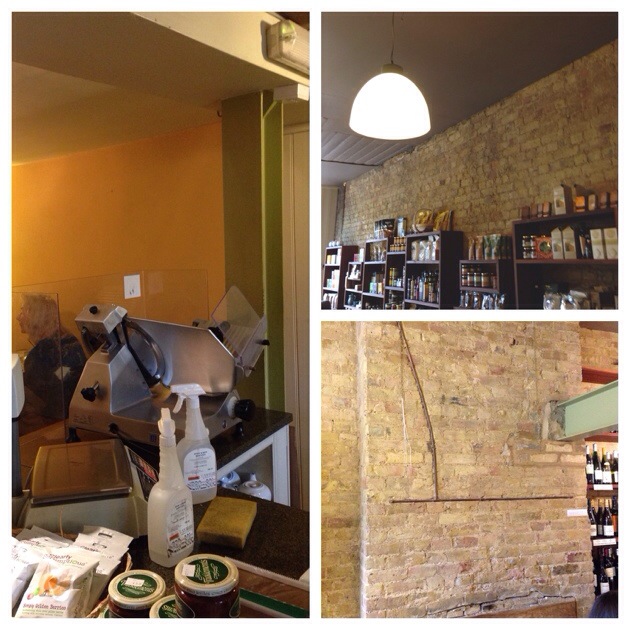 No one like exposed brickwork more than Wansteadium, but the walls of the Larder are looking pretty bare at the moment.